
Re-reading 'Brave New World' in the Age of AI
- Schools ON AIR

- Mar 13
- 3 min read
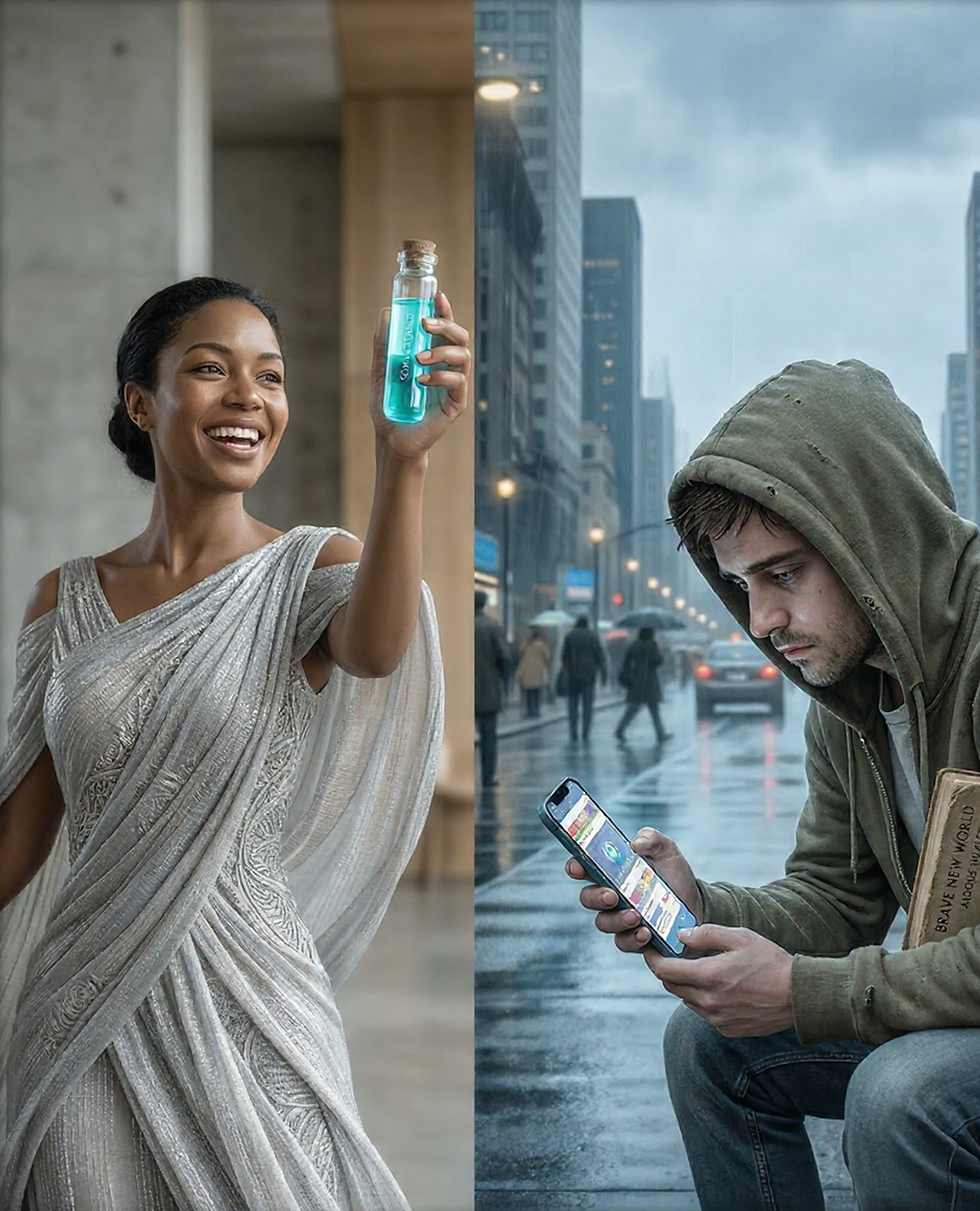
Lately, a certain book has been sending chills down my spine. That book is Brave New World. Published by Aldous Huxley in 1932, this novel feels more realistic today—nearly a century later—than ever before. As we witness the rapid evolution of AI and robotics, Huxley’s vision of the future feels less like a mere fantasy and more like a mirror reflecting our own era.
The story is set in the year 2540 AD. On the surface, it is a perfect society. There is no disease, no poverty, and no war. Everyone lives a stable life, and society operates with remarkable order. However, behind this tranquil facade lies a structure that has stripped away humanity. Humans are mass-produced in factories, with their intelligence and physical abilities predetermined before birth. Individual emotions or pain are seen as threats to social stability. Whenever someone feels the slightest bit of anxiety or sadness, they take a drug called "Soma" to induce instant happiness and hallucinations. Elements that create spiritual depth—family, art, philosophy, and religion—are strictly excluded as dangerous distractions. Ultimately, the people of this society become "happy slaves"—painless, but soulless.
The startling part is how closely this setting resembles our current reality. When I think of "Soma," the modern smartphone naturally comes to mind. Today, we spend our entire lives immersed in content recommended by algorithms. AI predicts what we will like, providing an endless stream of videos and articles to keep us captivated. Under the guise of convenience, we are gradually moving away from thinking and choosing for ourselves, instead following pre-selected options. This is not much different from the citizens in the novel who are subconsciously conditioned through hypnopaedia (sleep-learning). In the end, we may be slowly surrendering our willpower to algorithms.
Another parallel is the issue of "caste." In Brave New World, human classes are determined through genetic manipulation. Today, a new divide is forming between those who possess data and technology and those who do not. As AI and automation advance, efficiency becomes the ultimate societal standard. Corporations and institutions chase faster, more accurate systems, and in the process, human labor is increasingly replaced by machines. If this trend continues unchecked, we may face a society where human value is judged not by creativity or character, but by "how efficiently one contributes to the system." There is a real danger of humans being treated not as dignified beings, but as mere components maintaining a massive machine.
One of the most striking scenes in the novel is a single sentence shouted by the protagonist, John (the "Savage"). Rejecting a civilization that offers nothing but convenience and a lack of pain, he declares: "I claim the right to be unhappy." While it may sound strange, this sentence captures the essence of humanity. Humans have grown by experiencing pain, failure, and scarcity; it is through these struggles that we developed creativity and empathy. If technology removes every discomfort and failure from our lives, will we truly be happier, or will we simply become emptier?
Ultimately, what we must protect is not simple convenience, but "human agency." Whether technology remains a tool to help us or becomes an invisible designer of our decisions depends on the attitude we adopt today. The question is whether we will become consumers of a life suggested by algorithms, or remain beings who determine our own direction, however inconvenient that may be. A truly human life is not created within perfectly designed stability. Meaning, individuality, and creativity are forged in the process of being inefficient, being slow, and sometimes experiencing failure.
One question remains: Will giant tech corporations and power structures simply allow humans to maintain this "initiative"? In an age where the power to predict and design human behavior through data and algorithms is growing, how can our right to choose be protected? In my next column, I will focus on this question and explore whether the fight for human agency in the age of AI is hopeful or bleak.
#BraveNewWorld #AldousHuxley #AI #ArtificialIntelligence #FutureSociety #DigitalSoma #HumanAgency #Algorithm #TechEthics #BookReview #ClassicLiterature #Philosophy #Humanity #TechVsHuman #FutureVision

Comments